Area & Perimeter 4th Grade | Engaging Classroom Practice
Teaching area and perimeter in 4th grade works best when students learn one concept at a time and practice using real-world examples.
While area focuses on the space inside a shape, perimeter measures the distance around it.
Students can understand the difference between the two by the use of visuals, models and consistent practice.


How Do You Teach Area and Perimeter in 4th Grade?
Area and perimeter are taught in 4th grade by helping students understand the difference between measuring space inside a shape (area) and measuring the distance around a shape (perimeter).
Instruction typically starts with concrete hands-on models, visual representations, and real-world examples before moving into the abstract world of formulas and problem-solving practice.
What Is Perimeter in 4th Grade?
Perimeter is the distance around the outside of a shape.
In 4th grade, students find perimeter by adding the lengths of all the sides.
Perimeter tells us how far it is to walk all the way around a shape.

While perimeter focuses on the distance around a shape, area looks at the space inside it.
What is Area in 4th Grade?
Area is the amount of space inside a shape.
In 4th grade, students find area by counting square units that cover the shape.
In the example below, the rectangle is divided into 6 equal squares.
Each square represents one unit of area.
The colored tiles show that area doesn’t change, even when the squares are covered or grouped differently. We still count 6 total square units inside the shape.

This helps students understand that area is about covering space, not the shape’s outline.
Common Area & Perimeter Mistakes (And How to Help)
Mixing Up Area and Perimeter
One of the most common mistakes is confusing area and perimeter.
Students may count the squares inside a shape when asked for perimeter, or add the sides around a shape when asked for area.
Using phrases like “go around” for perimeter and “space inside” for area can help keep the two concepts clear.
Counting Squares Instead of Adding Sides (Perimeter)
When finding perimeter, students sometimes count the squares inside a shape instead of adding the lengths of the outside edges.
Perimeter only includes the sum of the outside edges of a shape.
Forgetting to Count All Sides (Perimeter)
Another common mistake for 4th graders is to leave out one or more sides when adding up the side lengths.
Tracing, or highlighting, with color around the shape can help students to remember to include all of the sides.

Counting Squares Incorrectly (Area)
When finding area, students may skip squares, double-count, or lose track when counting one by one.
The use of arrays or using a grid can make counting easier and more accurate.
Jumping to Formulas Too Soon (Area)
Some students try to use formulas before fully understanding what area represents.
Starting with counting square units of simple squares and rectangles helps build a strong foundation before moving on to multiplication.
The use of clear visuals and consistent language help students avoid these mistakes and build confidence with both area and perimeter.
Fun Ways to Practice Area and Perimeter
Once students understand the difference between area and perimeter, practice helps the skills really stick. Providing a mix of hands-on and visual activities keeps learning engaging while reinforcing accuracy.
Use Visual Mazes
Maze-style activities give students a clear purpose while practicing math.
As students move through the maze, they must carefully calculate area or perimeter to find the correct path, encouraging engagement and problem-solving, while reinforcing skills.
Using familiar layouts—such as zoo habitats, theme parks, or water parks—helps students see how area and perimeter apply beyond the worksheet.
Realistic settings make measurements feel more meaningful and relatable.
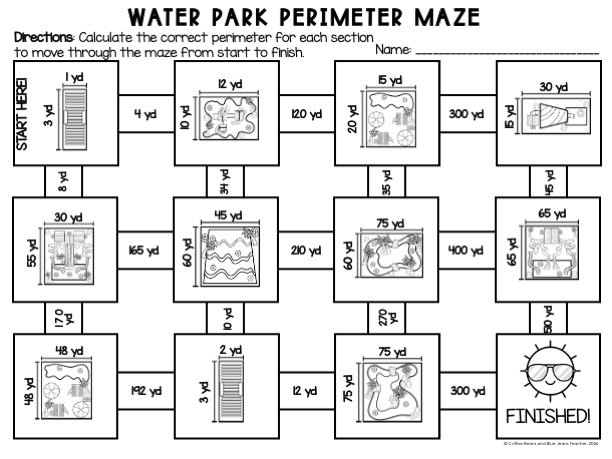
Area and perimeter mazes work well for math centers, independent practice, or partner activities.
Students can explain their thinking to a partner or self-check as they move through each section.
When time is limited, having ready-to-use practice makes it easy to review skills without extra setup.
Activities that focus on one skill at a time help students build confidence before combining concepts.
A Ready-to-Use Option
If you’re looking for a simple way to reinforce both skills, I’ve created a 4th Grade Area & Perimeter Math Mazes Bundle featuring zoo, theme park, and water park layouts.
Each maze focuses on a single skill, making it easy to use for centers, review, or early finishers.
Clear explanations and engaging practice help make area and perimeter in 4th grade easier to understand and apply.
Image sources: Magnetic tile clipart in graphics by Little Bunnies Designs and themed-section clipart for zoo, theme park and water park by Doodles and Digits.